
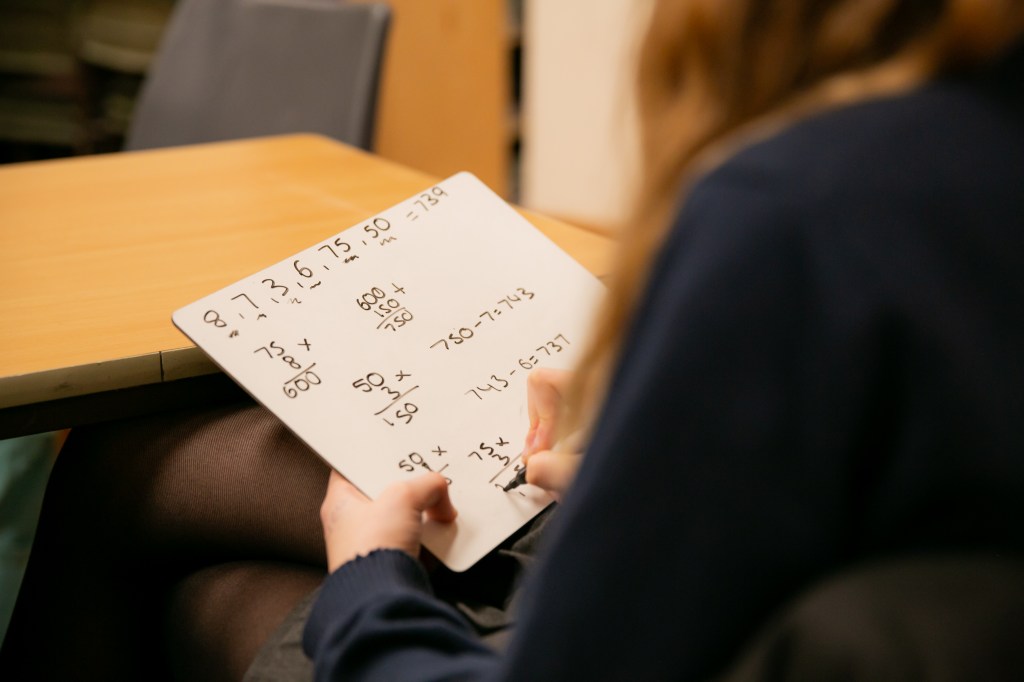
For many families, maths can become associated with homework battles, frustration or the looming pressure of SATs and GCSEs. It’s easy for children to think of maths as something that only happens in the classroom or during revision sessions.
The good news is that some of the most valuable mathematical learning happens away from a worksheet. By weaving maths into everyday life, parents can help their children see it as a practical, useful and even enjoyable subject. Better still, these activities often feel like quality family time rather than extra schoolwork.
Here are some simple ways to make maths more engaging at home, whatever your child’s age.
Cook Together
Cooking is one of the easiest ways to bring maths to life. Measuring ingredients introduces younger children to numbers, fractions and volume, while older children can practise scaling recipes up or down.
Ask questions such as:
- “If we double this recipe, how much flour will we need?”
- “What happens if we only want to make half as many cakes?”
- “How long will everything take if we start cooking at 5:30?”
Without even realising it, children are using multiplication, division, fractions and time calculations in a meaningful way.
Play Games That Use Numbers
Board games and card games provide fantastic opportunities to practise mathematical thinking.
Games involving dice encourage mental addition, while strategy games develop logical reasoning and problem-solving skills. Even classic card games help children recognise number patterns and make quick calculations.
The important thing isn’t finding the most educational game, it’s choosing something your child genuinely enjoys.
Make Shopping a Maths Challenge
Whether you’re doing the weekly supermarket shop or buying something online, there are plenty of opportunities to involve children.
You could ask:
- “Which product offers the best value?”
- “How much change should we expect?”
- “If something is 25% off, roughly how much will it cost?”
- “Can we stay within a certain budget?”
Older children preparing for GCSEs will regularly encounter percentage, ratio and budgeting questions, so these real-life examples help make abstract concepts much more relatable.
Spot Maths Everywhere
One of the best ways to change a child’s mindset is to point out just how often maths appears in everyday life.
You might notice:
- Shapes and symmetry in buildings.
- Patterns in nature.
- Speed and distance when travelling.
- Timetables and schedules.
- Sports statistics.
- Weather forecasts and temperatures.
When children begin recognising maths outside school, it starts to feel much more relevant and less like a subject that only exists in textbooks.
Encourage Estimation
Children often worry about getting the exact right answer, but estimation is an incredibly valuable mathematical skill.
Try asking questions such as:
- “How many sweets do you think are in the jar?”
- “How many steps will it take to reach the car?”
- “How long do you think this journey will take?”
The aim isn’t precision, it’s encouraging children to think mathematically and explain their reasoning.
Celebrate the Process, Not Just the Answer
One of the biggest confidence boosters is helping children understand that mistakes are a normal part of learning.
If your child gets stuck, avoid jumping straight to the correct answer. Instead, ask questions like:
- “How did you work that out?”
- “Can you think of another way?”
- “Which part feels tricky?”
This encourages resilience and helps children develop confidence in their own thinking rather than simply searching for the right answer.
Keep Screen Time Meaningful
Technology can also play a positive role when used in moderation. There are many maths games and puzzle apps that encourage logical thinking, number fluency and problem-solving through play rather than repetitive practice.
The best resources are those that feel like games first and learning second.
Keep It Relaxed
Perhaps the most important tip of all is not to turn every activity into a lesson.
Children quickly pick up on pressure, and if every game becomes a test, the fun disappears. Instead, enjoy conversations, ask curious questions and celebrate effort. Even spending ten minutes discussing numbers while cooking dinner or walking to school can have a lasting impact.
When maths feels approachable and relevant, children are far more likely to develop confidence and curiosity – qualities that support them throughout primary school, secondary school and beyond.
At Conexus Tuition, we believe confidence grows through understanding, encouragement and positive experiences. By making maths part of everyday family life, you’re helping your child build skills that extend far beyond the classroom, laying strong foundations for future learning while showing them that maths can be both useful and enjoyable.
 Conexus Tuition Southbourne, Christchurch, and Bournemouth East
Leave a comment