
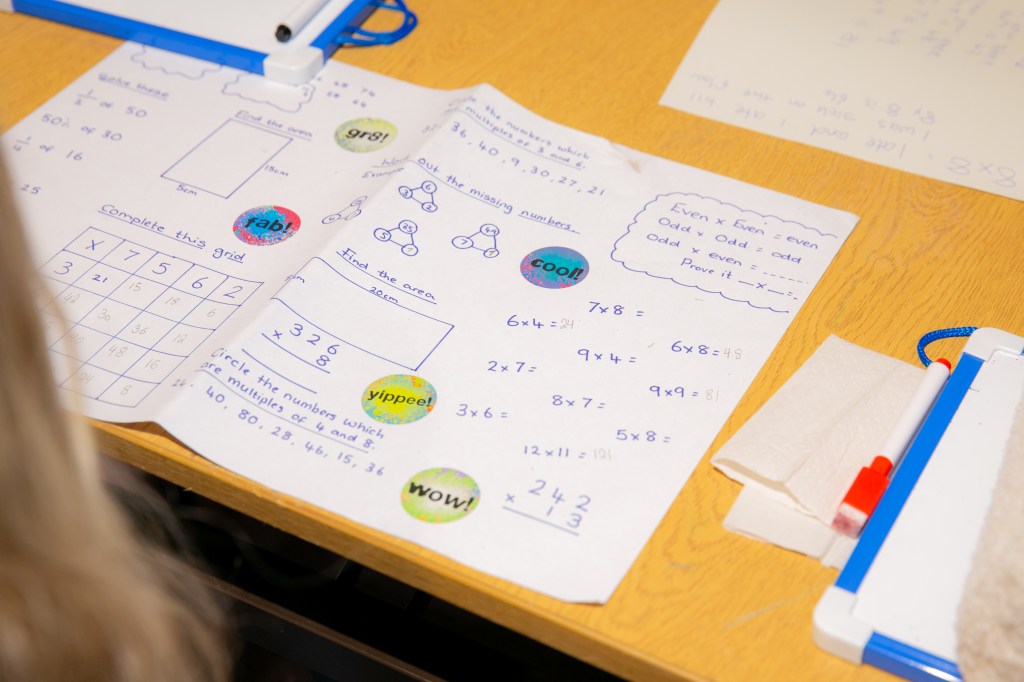
For many parents, helping children learn their times tables can feel like a routine part of primary school homework. However, in Year 4 it becomes particularly important. At this stage in England’s curriculum, children are expected to know their multiplication tables up to 12 × 12 and demonstrate quick recall. This knowledge is not just about passing a test – it forms a foundation for much of the maths they will encounter later in primary school and beyond.
The Year 4 Multiplication Tables Check
Since 2022, all Year 4 pupils in state-funded schools in England take the Multiplication Tables Check (MTC). This short online assessment asks children 25 questions on multiplication facts up to 12 × 12, with only six seconds to answer each question. The purpose is to measure how fluently children can recall their times tables.
National data suggests that standards are gradually improving. In the 2025 check, the average score across England was around 21 out of 25, and 37% of pupils achieved full marks, showing that many children are developing strong recall skills.
Although there is no official “pass mark”, the assessment helps schools identify pupils who may need extra support before moving into more advanced maths topics.
Times Tables: The Building Blocks of Maths
Times tables are often described as the building blocks of mathematics. When children can quickly recall multiplication facts, they can focus on understanding more complex concepts rather than spending time calculating basic sums.
In Year 4 and beyond, pupils begin learning topics such as:
- Formal written multiplication and division
- Fractions (including equivalent fractions)
- Area and perimeter
- Problem-solving involving multi-step calculations
Without secure knowledge of multiplication facts, these topics become significantly more challenging. For example, when solving a fraction problem or dividing larger numbers, children often rely on multiplication facts to find answers quickly.
If a child already knows that 6 × 8 = 48 instantly, they can concentrate on understanding the new method being taught rather than working out that multiplication first.
Reducing Cognitive Load
Another key benefit of memorising times tables is reducing what educators call “cognitive load.” In simple terms, this means freeing up a child’s working memory.
When children are learning new mathematical procedures (such as long multiplication or division) they must think about several steps at once. If they also have to work out basic multiplication facts during the process, their mental load increases and mistakes become more likely.
By knowing their times tables automatically, children can focus on the method rather than the calculation, which helps them learn new topics more quickly and confidently.
Confidence and Enjoyment in Maths
Confidence is another major benefit. Children who know their times tables well often feel more capable during maths lessons. They are less likely to rely on counting on fingers or calculators and can approach problem-solving tasks with greater independence.
This confidence can influence how children view maths overall. Feeling successful in lessons can increase motivation and encourage a positive attitude towards the subject – something that becomes increasingly important as maths gets more complex in upper primary and secondary school.
Skills That Extend Beyond the Classroom
Times tables also support everyday numeracy skills. Multiplication helps with tasks such as:
- Working out the total cost of several items
- Understanding discounts or offers
- Estimating quantities or measurements
According to the Department for Education, strong maths skills help people make practical calculations in daily life, from budgeting to comparing prices in shops.
How Parents Can Help
The good news is that regular, short practice sessions can make a big difference. Just a few minutes a day of recalling facts, playing maths games, or practising with online tools can strengthen a child’s recall over time. Encouragement and patience are key. Times tables are not learned overnight, but with consistent practice children can build the fluency they need.
Year 4 is a crucial stage for mastering times tables. These basic multiplication facts underpin many of the mathematical skills children will use throughout primary school and into secondary education. By helping children develop quick and confident recall now, parents can support their child’s success in maths for years to come.
In short, times tables are not just another homework task – they are a gateway to understanding the wider world of mathematics.
 Conexus Tuition Southbourne, Christchurch, and Bournemouth East
Leave a comment